
GCSE Mock Exams Explained: Everything Parents Need to Know (Without the Panic)
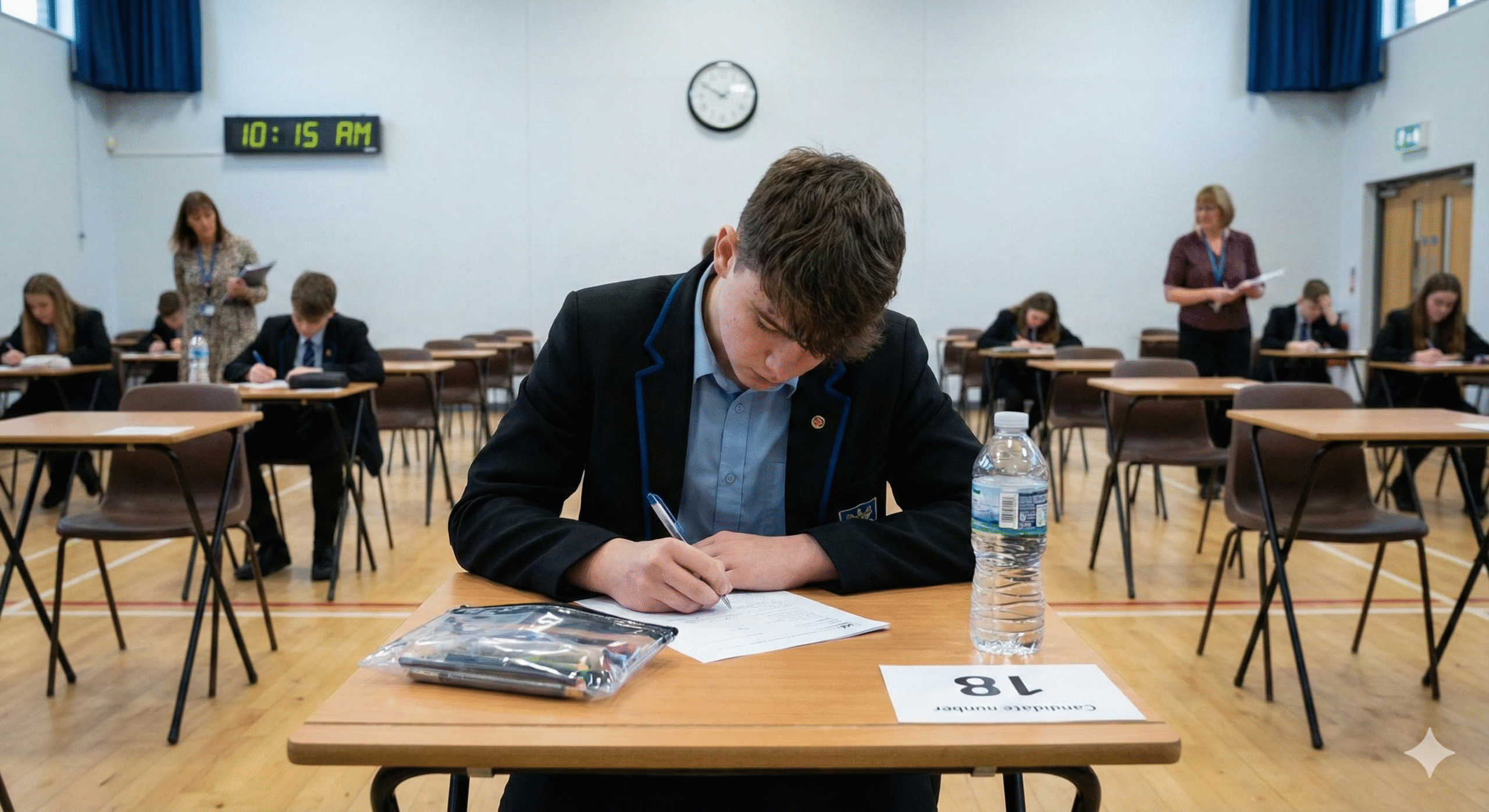
Right, let’s talk about GCSE mock exams. If your child’s in Year 10 or 11, you’ve probably heard the term thrown around, and if you’re anything like I was the first time round, you’re probably wondering what the actual point of them is and whether you should be worried.
The short answer? Mock exams are practice runs of the real GCSEs, usually taken in November and again in February of Year 11. They’re designed to give students (and teachers, and yes, us parents) a realistic idea of where things stand before the actual exams in May and June.
The slightly longer answer involves understanding why schools do them, what they actually mean for your child’s final grades, and how to help without making things worse. Which, let’s be honest, is the tricky bit.
What Actually Are Mock Exams?
Mock exams – sometimes called “prelims” in Scotland or just “mocks” everywhere else – are full-length practice exams that replicate the real GCSE experience as closely as possible. We’re talking proper exam hall, timed conditions, invigilators walking around, the works. Some schools even make students sit in exam number order just to add that extra layer of authenticity (and stress).
The papers themselves are usually one of three things:
Past papers from previous years – Schools pull out papers from 2022, 2023, or 2024 and use those. This is the most common approach because it’s cheap and the mark schemes already exist.
Predicted papers – These are papers created by educational companies like Maths Genie, Physics & Maths Tutor, or the big publishers. They analyze past papers and try to predict what might come up. Some of them are genuinely good; others are… well, optimistic.
School-created papers – Some teachers write their own mock papers by mixing questions from various past papers. Quality varies wildly depending on how much time the teacher had and whether they remembered to include an equation sheet.
The key thing to understand is that mock exams aren’t official. They’re not set by the exam boards (AQA, Edexcel, OCR, etc.), they don’t appear on any official transcript, and they absolutely do not count towards final GCSE grades. More on that in a minute, because I know what you’re thinking.
When Do Mock Exams Happen?
Most schools run two rounds of mocks for Year 11 students:
November/December mocks – Usually start in mid-November and run through early December. These are often called the “first mocks” or “November mocks” and they happen after students have been back at school for about 10 weeks. Timing-wise, it’s brutal – right when everyone’s getting tired and Christmas is dangling just out of reach.
January/February mocks – These happen after the Christmas break, typically starting in mid-January and running into early February. Some schools call these the “real” mocks because they’re closer to the actual exams and supposedly a better predictor of final grades.
Some schools also do Year 10 end-of-year exams in May or June, which are essentially mocks but with less fanfare. The point of these is to give students a taste of exam conditions before they hit Year 11 proper.
The actual schedule varies by school. Some spread mocks out over three weeks; others cram them into one hellish fortnight. Some schools give students half-days or study leave during mocks; others expect them to sit an exam in the morning and then attend afternoon lessons like nothing happened.
Check your school’s calendar because trust me, finding out about mocks a week in advance is not fun for anyone.
Why Schools Do Mock Exams (And Why They Matter More Than You’d Think)
Here’s where it gets interesting. Mock exams don’t count towards final grades, but they matter. A lot. Just not in the way most people think.
For students: Mocks are a practice run. They expose gaps in knowledge, highlight weak exam technique, and – crucially – give students a chance to experience exam pressure before it actually counts. The first time you sit in an exam hall for two hours with nothing but a pen and a question paper is genuinely stressful. Better to have that experience in November when you can learn from it than in May when it’s too late.
Mocks also show students what exam questions actually look like. You can do past papers at home, but there’s something about the timed pressure that makes your brain work differently. Students often come out of mocks realizing they need to speed up, or that they’re spending too long on certain types of questions, or that they’ve been revising the wrong topics entirely.
For teachers: Mock results tell teachers which topics the whole class is struggling with. If everyone bombs the same question on circle theorems, that’s a sign the teacher needs to go back and reteach it. Mocks also help teachers identify students who might need extra support or intervention before the real exams.
For predictions and references: This is the big one, and it’s controversial. Universities, colleges, and sixth forms usually ask for “predicted grades” when students apply. Teachers base these predictions largely on mock exam results. If your child’s planning to apply for a competitive A-Level course or sixth form, their mock results could influence whether they get offered a place.
Similarly, teachers writing references for university applications (UCAS) often reference mock exam performance. So while mocks don’t technically count, they definitely matter for what comes next.
For schools and Ofsted: Schools track mock results as part of their internal data. They use them to predict how many students will hit certain grade thresholds (like the government’s target of students getting grade 5 or above in English and Maths). If mock results are terrible across the board, that sets off alarm bells and usually triggers intervention strategies.
Do Mock Exam Results Count Toward Final Grades?
No. Absolutely not. Never.
This is worth repeating because it’s one of the most common misconceptions: mock exam results do not appear on your child’s final GCSE certificate and are not part of their official grades.
The only time this gets complicated is if external exams get cancelled – like they were during Covid in 2020 and 2021. In those years, students were awarded “Centre Assessed Grades” (CAGs) or “Teacher Assessed Grades” (TAGs), which were based partly on mock results, coursework, and other assessments. But that was an exceptional situation and we’re back to normal exam-based GCSEs now.
So if your child gets a Grade 4 in their November mocks but a Grade 7 in the real thing, that’s the only grade that matters. The Grade 4 exists purely as a learning tool.
That said – and this is important – mock results do affect predicted grades, references, and sixth form applications as I mentioned above. So while they don’t directly count, they’re not meaningless either.
What Results Actually Mean (And How to Interpret Them)
Let’s say your child comes home and tells you they got a Grade 5 in their November mock for Maths. What does that actually mean?
First, consider the timing. November mocks happen when students are about 65-70% through their GCSE course. They haven’t covered everything yet. Most teachers don’t expect students to hit their target grades in November mocks – it’s more about getting a baseline.
A common rule of thumb is that students tend to improve by one grade between November mocks and the real exams in May/June. So a Grade 5 in November might translate to a Grade 6 or even Grade 7 in the real thing, assuming they keep working. This isn’t guaranteed, obviously, but it’s a pattern teachers see year after year.
February mocks are a better predictor because students have covered more content and had more practice. If someone’s getting a Grade 6 in February, they’re more likely to achieve something close to that in the actual exams.
But here’s the thing: mock exams can be harder than the real thing. Some schools deliberately use tough papers to “scare students into revising” (their words, not mine). Others set the grade boundaries harshly. I’ve seen schools where a raw score of 55/80 gets marked as a Grade 5 in mocks but would be a Grade 6 in the real exam.
Check with your child’s teachers about how grade boundaries are being set. If the school’s using past paper boundaries from the exam board, that’s accurate. If they’re using their own boundaries, take the grades with a pinch of salt.
How to Actually Help Your Child With Mock Exams
Right, this is the practical bit. Here’s what actually helps:
Create a revision timetable together – Notice I said “together,” not “force them to follow your timetable.” Sit down with your child, look at the exam schedule, and work backwards. Which subjects need the most attention? Which exams are on the same day? Build in breaks. Make it realistic.
CGP GCSE Revision guides are brilliant for this because they break everything down by topic – you want the ones that match your child’s exam board (AQA, Edexcel, or OCR) and tier (Foundation or Higher). Most students find it easier to revise when they can work through one specific topic at a time rather than staring at an entire textbook. The Complete Revision & Practice guides include all the topics, practice questions, and mark schemes in one place, which honestly just makes life simpler during mock season.
Help them find past papers and mark schemes – The exam board websites (AQA, Edexcel, OCR, Eduqas) have free past papers and mark schemes. Download them. Print them if your child works better on paper than screen. Get them practicing under timed conditions.
If you’re looking for more structured practice, companies like Cognito and Seneca Learning offer free online resources organized by topic. The Physics & Maths Tutor website is also excellent for sciences and maths.
Sort out the practical stuff – Do they have the right calculator for Maths and Science? Most schools require a Casio scientific calculator – specifically the Casio fx-83GTX or fx-991EX models are the ones schools recommend. Basic calculators aren’t allowed in GCSE exams, and finding out on exam day that you’ve got the wrong one is the kind of stress nobody needs.
Do they have enough pens, pencils, a ruler, a protractor, a compass? It sounds trivial but trust me, not being able to find a working compass on exam morning creates unnecessary stress.
Focus on sleep and food – I know, I know, this sounds like generic parenting advice. But genuinely, students who are exhausted or haven’t eaten perform worse. Try to maintain normal bedtimes in the weeks before mocks. Make sure they’re eating breakfast on exam days, even if it’s just toast.
Don’t compare them to other people’s children – I mean this kindly but firmly: comparing your child’s mock results to their cousin’s or their friend’s or that kid down the road who’s apparently a genius is utterly pointless and deeply unhelpful. Every child is different. Every school sets different mock papers. Focus on whether your child is improving, not whether they’re beating someone else.
Know when to back off – This is the hardest one. If your child is genuinely working hard and still stressed, sometimes the best thing you can do is tell them to take a break. Burnout is real, and it’s counterproductive. If they’ve been revising for six hours straight, they need to stop and do something else.
What If Mock Results Are Really Bad?
Let’s talk worst-case scenario. Your child’s mock results come back and they’re well below target grades. Maybe they’ve failed multiple subjects. What now?
First: don’t panic. Remember, mocks are meant to expose problems while there’s still time to fix them. That’s literally their purpose.
Second: talk to the school. Book a parents’ evening appointment or email the head of year. Ask specific questions:
- Which topics did my child struggle with?
- Is this a knowledge gap or an exam technique issue?
- What intervention or support is the school offering?
- What can we do at home to help?
Most schools have intervention strategies for students who underperform in mocks. This might be after-school revision sessions, one-to-one tutoring, or being moved to a different tier (Foundation vs Higher) if that’s appropriate.
Third: consider getting extra help. This might mean a private tutor, online tutoring platforms like MyTutor, or even just working through revision workbooks together at home. The CGP 10-Minute Tests are good for this because they’re short, focused practice sessions rather than overwhelming three-hour marathons.
But – and this is crucial – make sure your child is actually willing to engage with the help. Forcing a tutor on a resistant teenager rarely works. Have an honest conversation about what they think would help.
The Emotional Side of Mock Exams
Let’s acknowledge something that doesn’t get talked about enough: mock exams can be genuinely distressing for some students.
I’ve seen otherwise confident kids have meltdowns over mock results. I’ve seen anxious students convince themselves they’re going to fail everything based on one bad paper. And I’ve seen completely checked-out teenagers shrug off terrible results because they don’t believe they matter.
All of these reactions are normal.
If your child is genuinely anxious about mocks – like, can’t sleep, losing appetite, crying regularly – that’s worth taking seriously. Talk to the school about whether they need any exam access arrangements (extra time, rest breaks, etc.). Talk to your GP if you think it’s affecting their mental health.
On the flip side, if your child seems completely unbothered by approaching mocks and you think they should be more concerned… well, you can express your concerns, but you can’t force someone to care. Sometimes teenagers need to experience natural consequences (i.e., bad mock results) before they’re motivated to change their approach.
Looking Ahead to the Real Thing
Here’s the thing I wish someone had told me when we were going through this: mock exams are not a crystal ball. They’re a snapshot of where your child is right now, in mid-November or mid-February, having covered about two-thirds of the content.
Students can and do improve dramatically between mocks and the real exams. They can also, occasionally, do worse if they get complacent or burn out. The mocks are a warning system, not a destiny.
Use mock results as information. If your child’s on track, great – keep doing what you’re doing. If they’re below target, okay – now you know where to focus effort for the next few months. If they’re exceeding expectations, brilliant – maintain that momentum but watch out for stress and perfectionism.
The actual GCSEs happen in May and June, about 4-6 months after the second round of mocks. That’s a lot of time to improve, fill knowledge gaps, and practice exam technique.
The Mock Exam Toolkit: What You Actually Need
Before I forget – because parents always ask me this – here’s what students actually need for mock exams:
The right revision guides: Get the CGP Complete Revision & Practice guides that match your child’s exam board. They’re about £10-12 each and include everything – topics, practice questions, and mark schemes. Much better than buying random revision books that might not align with what they’re actually being tested on.
A proper calculator: The Casio fx-83GTX or fx-991EX. Not negotiable for Maths and Science GCSEs. Amazon has them for around £15-20.
Basic stationery: Pack of black pens (not blue – some exam boards are particular), pencils, rubber, ruler, protractor, compass. Get a pencil case that zips shut properly. Nothing worse than pens rolling onto the floor mid-exam.
A realistic revision timetable: Sounds boring, but it genuinely helps. There are free printable templates online, or just use a wall calendar and some coloured markers.
Past papers: Free from exam board websites, or buy the CGP Exam Practice Workbooks if you want everything printed and organized in one place.
A quick note on affiliate links: I include Amazon links to resources I genuinely recommend and use myself. If you buy through them, I earn a small commission at no extra cost to you – it just helps keep this site running while I’m here answering panicked WhatsApps from other parents at 11pm. I only link to products I’d recommend to my own kids.
Related Articles You Might Find Helpful
GCSE Results Day 2026: Everything Parents Need to Know
From when results come out to what happens if grades aren’t what you expected – a complete parent’s guide to results day.
Sparx Maths: A Parent’s Guide to Understanding the Homework Platform
What is Sparx Maths, how does it work, and how can you actually help your child without doing the work for them?
The 11+ Exam Explained: A Realistic Parent’s Guide
Thinking about grammar school? Here’s what the 11+ actually involves and whether it’s the right choice for your family.
How to Create a GCSE Revision Timetable That Actually Works
Forget the Pinterest-perfect colour-coded nonsense. Here’s how to build a realistic revision plan your teenager might actually follow.