
GCSE Exams Explained: The Complete Parent’s Guide (2025)
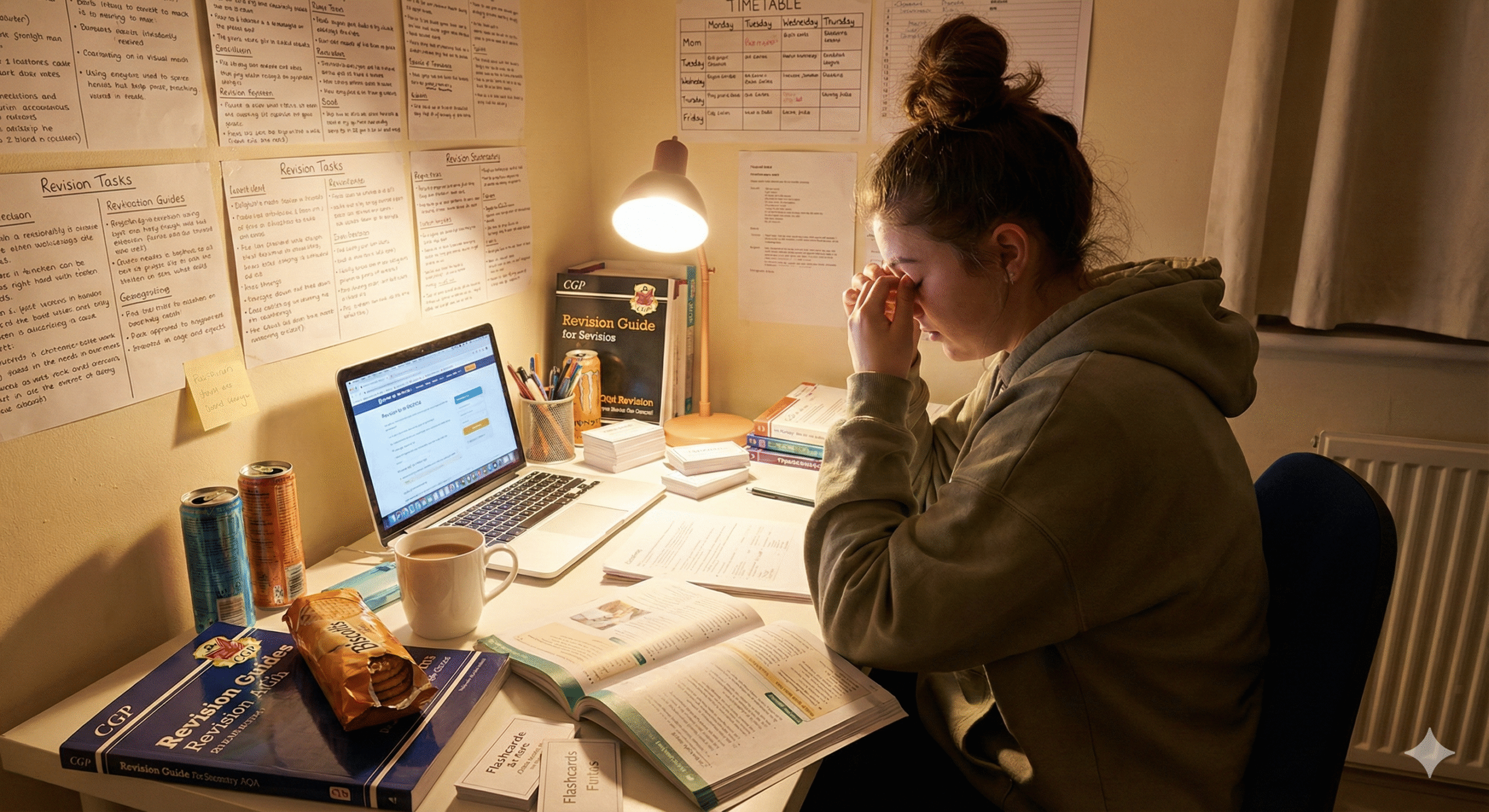
If you’re reading this, chances are your child is approaching Year 9 or already deep into their GCSE journey, and you’re trying to make sense of a system that looks nothing like the one you remember. I get it. When my eldest started choosing options, I found myself nodding along at parents’ evening while secretly wondering what half of it meant. The grading system has changed, the subjects have evolved, and somehow we’re all supposed to guide our children through this while pretending we understand what a “grade 4” actually means.
This guide is what I wish someone had given me back then: a straightforward explanation of what GCSEs are, how they work now, and what you actually need to know to support your child without losing your mind in the process.
What exactly is a GCSE?
GCSE stands for General Certificate of Secondary Education. These are the qualifications that UK students typically take between the ages of 14 and 16, during what’s officially called Key Stage 4 (Years 10 and 11). Think of GCSEs as the academic checkpoint at the end of compulsory secondary education – the point where your child’s choices start to have real consequences for their future options.
Unlike the casual tests they’ve done throughout school, GCSEs are national qualifications. The same exams are sat across the country, marked to the same standards, and recognized by every sixth form, college, and employer in the UK. They’re the gateway to A-levels, BTECs, apprenticeships, and eventually university or work. No pressure, right?
Here’s the thing though: while GCSEs are important, they’re not the be-all and end-all. I’ve watched enough results days to know that there are always routes forward, whatever the outcome. But understanding the system helps you and your child navigate it with less stress and more confidence.
The 9-1 grading system (and why it’s so confusing)
If you took GCSEs yourself, you’ll remember the A* to G grading system. That made sense. An A was brilliant, a C was decent, anything below was worrying. Simple. Then in 2017, the government decided to overhaul everything and introduce a numerical system running from 9 (the highest) down to 1 (the lowest). If you’re wondering why they did this – well, join the club. The official reason was to allow better differentiation at the top end and signal that these were “new, more rigorous” qualifications.
The practical result is that millions of parents now sit in school halls trying to work out whether a grade 6 is good or not, while their own parents ask if their grandchild got any A*s.
Here’s the comparison that actually helps:
| Old Grades (A*-G) | New Grades (9-1) |
|---|---|
| (Above A*) | 9 (Top Performers) |
| A* | 8 |
| A | 7 |
| B | 6 |
| C (High) | 5 (Strong Pass) |
| C (Low) | 4 (Standard Pass) |
| D | 3 |
| E | 2 |
| F / G | 1 |
| U | U |
The crucial thing to understand is the concept of a “pass.” In the new system, a grade 4 is considered a “standard pass” – roughly equivalent to a low C in the old system. A grade 5 is a “strong pass” – more like a high C or low B. Most sixth forms and colleges want to see at least grade 5s in English and Maths, and many will ask for grade 6 or above if your child wants to study a subject at A-level.
Grade 9 is genuinely rare. It’s awarded to the very top performers – fewer students get a 9 than used to get an A*. If your child achieves even one grade 9, that’s genuinely exceptional. Don’t let anyone tell you otherwise.
How many GCSEs should your child take?
This is one of the first questions parents ask, usually followed quickly by “Is my child taking too many?” or “Should they be doing more?”
The typical answer is that most students take between 8 and 10 GCSEs. Some schools offer more, some fewer, but that’s the normal range. The absolute minimum to keep options open for further education is usually 5 GCSEs including English and Maths. Anything beyond about 11 GCSEs starts to become genuinely difficult to manage without burning out.
Here’s what I learned: it’s not a competition. Taking 12 GCSEs and getting middling grades across all of them is far less useful than taking 9 and doing really well in them. Universities and employers care much more about the quality of the grades than the quantity of subjects. One friend’s daughter took 8 GCSEs, got mostly 8s and 9s, and sailed into her first-choice sixth form. Another took 11, struggled to keep up, and ended up with results that didn’t reflect her ability at all.
The other thing to consider is wellbeing. Year 11 is intense enough without adding unnecessary pressure. If your child is juggling school, perhaps a part-time job or serious extracurriculars, and trying to maintain some semblance of a social life, 8 or 9 well-chosen GCSEs is absolutely fine.
Compulsory subjects vs optional subjects
Three subjects are compulsory for every student in England: English, Maths, and Science. Most schools split English into two separate GCSEs (English Language and English Literature), so that’s actually four qualifications just from the core subjects. Science can be taken as “Combined Science” (which counts as two GCSEs and covers Biology, Chemistry, and Physics in a condensed way) or as three separate sciences (Biology, Chemistry, and Physics as individual GCSEs). The separate sciences go into more depth and are often recommended for anyone thinking about science A-levels.
Beyond these core subjects, your child gets to choose. Common options include History, Geography, a modern foreign language (French, Spanish, German), Religious Studies, Art, Drama, Music, Computer Science, and various technology or vocational subjects. The exact options vary by school – some offer triple science and three languages, others have a narrower menu.
The choices happen in Year 9, which feels impossibly early when your child is still figuring out who they are, let alone what they want to do for a living. The best advice I can give is to encourage them to pick subjects they genuinely enjoy and are good at, while keeping at least one or two that align with possible future paths. If they’re thinking about science or medicine, take the separate sciences. If languages are their thing, don’t drop them just because they’re “hard.”
For parents trying to support their child in these core subjects, resources like CGP’s GCSE Maths Revision Guide and CGP’s English Language & Literature guide can be genuinely helpful. They’re written in a way that actually makes sense – not just to teenagers, but to parents trying to remember how quadratic equations work or what a metaphor is. I’m not saying you need to become an expert, but having something clear to refer to when your child asks for help at 9pm the night before a mock exam is a lifesaver.
The GCSE timeline: from Year 9 to Results Day
Understanding the timeline helps you know what’s coming and when to start paying attention. Here’s how it typically unfolds:
Year 9 (age 13-14): Your child chooses their GCSE options, usually around February or March. Schools hold options evenings where they explain the choices and try to guide students toward sensible combinations. This is when you want to have conversations about what they enjoy, what they’re good at, and what doors they might want to keep open.
Year 10 (age 14-15): GCSE teaching begins properly. For most subjects, Year 10 is about building the foundation – learning the content, developing the skills, starting to get familiar with exam technique. Some schools do “end of Year 10” exams, but these are usually internal assessments rather than anything official. It’s a relatively calm year, all things considered. This is the year to help your child develop good habits: a regular revision routine, organized notes, a decent workspace at home.
Year 11 (age 15-16): This is where it gets real. Teaching continues through until Easter-ish, but the intensity ramps up significantly. Most schools run “mock exams” in November or December, which are practice exams under real exam conditions. These can be surprisingly stressful – they feel like the real thing, and the results give everyone (students, teachers, parents) an idea of where things stand. Mock results often act as a wake-up call. You’ll also hear about “November mocks” and possibly “March mocks” depending on your school.
The actual GCSE exams happen in May and June. They’re all externally marked, and they’re the only thing that counts toward the final grade – there’s no coursework in most subjects anymore (Art and Drama being notable exceptions). Then comes the wait. Results Day is in mid-August, usually a Thursday. It’s nerve-wracking, emotional, and occasionally surprising in both directions.
If you want to understand more about what to expect on that day and what to do if results aren’t what you hoped, our guide to GCSE Results Day 2026 walks through all of that in detail.
Why GCSEs matter (and why they don’t define everything)
Let’s be honest: GCSEs matter. They’re the first major academic hurdle your child faces, and the results directly affect their next steps. Want to do A-levels? You’ll need certain GCSE grades. Want to get into a competitive sixth form? They’ll be looking at your GCSEs. Even apprenticeships often ask for English and Maths at grade 4 or above.
Universities don’t usually make offers based on GCSEs – they care far more about A-level results – but they do look at them. Some highly competitive courses (medicine, veterinary science, Oxbridge) will expect to see lots of 8s and 9s at GCSE as evidence of consistent high performance. For most other courses, having decent GCSEs is enough; it’s the A-levels that really matter.
But here’s what I want you to know: GCSEs are not the end of the world. I know teenagers who got results that devastated them at the time but who went on to resit, take different routes, and end up exactly where they wanted to be. I know others who aced every GCSE and then decided A-levels weren’t for them. The education system in the UK has more flexibility than it sometimes seems.
What matters most during this time is supporting your child without adding to the pressure. They know GCSEs are important – trust me, their school has made that very clear. What they need from you is perspective, reassurance, and practical help where you can give it.
How you can actually help (without losing your mind)
This is the part where I’m supposed to tell you to create a color-coded revision timetable, quiz your child every evening, and transform into a motivational speaker crossed with a private tutor. But honestly? That’s not realistic, and it’s not what most teenagers need.
What actually helps is this: Create a calm environment at home. That doesn’t mean silence 24/7, but it does mean not having massive arguments during revision season, trying to keep mealtimes regular, and having a space where your child can work without constant interruptions.
Be interested without being intrusive. Ask how revision is going, but don’t interrogate them. If they want to talk about what they’re learning, great. If they don’t, don’t push it. The number of times I’ve asked “How was the exam?” only to get a grunt in response is… well, let’s just say I’ve learned to let it go.
Help them get organized. This is where things like CGP’s How to Revise for GCSE guide can be really useful. It’s not about you becoming their study coach – it’s about giving them the tools to manage their own revision. The guide covers everything from making revision timetables to dealing with exam stress, and it’s written for teenagers, not academics. I bought one for my daughter, and while she didn’t follow it religiously, it at least gave her a framework when she was feeling overwhelmed.
Watch for signs of real stress. A bit of anxiety before exams is normal. Not sleeping, not eating, constant panic – that’s not okay. If you’re worried, talk to your child’s form tutor or head of year. Schools deal with exam stress all the time and often have support in place.
And finally: remind them that you’re proud of them regardless. I know that sounds like parenting 101, but it’s so easy for teenagers to internalize the message that their worth is tied to their grades. It’s not. Whatever happens in those exam halls, they’re still your kid, and this is just one chapter of their story.
What counts as a “pass” these days?
I covered this briefly earlier, but it’s worth emphasizing because it causes so much confusion. In the new grading system, there are technically two pass marks:
Grade 4 is the “standard pass.” This is what the government considers a pass, and it’s roughly equivalent to the old grade C. If your child gets grade 4 in English and Maths, they’ve met the minimum requirement and won’t have to resit those subjects (unless their sixth form or college requires higher).
Grade 5 is the “strong pass.” This is closer to a high C or low B in the old system. Many sixth forms set grade 5 as their entry requirement for English and Maths, and some will want grade 6 or above in a subject if your child wants to study it at A-level.
So when your child comes home and says they got a grade 5 in History, that’s good. It’s a solid pass, and it’s what most schools and colleges are looking for. If they got a grade 4, that’s still a pass – it’s absolutely nothing to be ashamed of, even if it’s not quite strong enough for some sixth form entry requirements.
For more detailed information about what happens if your child doesn’t get the grades they need, or if they want to resit, our article on GCSE Results Day options covers all of that.
Looking ahead: what comes after GCSEs?
The traditional route after GCSEs is sixth form (either at the same school or a separate sixth form college) to study A-levels. Most students take three A-levels, sometimes four if they’re particularly ambitious or the subjects are quite different. A-levels are more specialized and more demanding than GCSEs, but they’re also more interesting – you’re studying subjects you’ve chosen because you actually enjoy them.
But A-levels aren’t the only option. BTECs are vocational qualifications that focus on practical skills and are particularly popular for subjects like Business, Health and Social Care, or Sport. They’re assessed mainly through coursework rather than exams, which suits some students much better. Many universities accept BTECs alongside or instead of A-levels.
Apprenticeships are another route – you earn while you learn, combining on-the-job training with study. They’re not just for trades anymore; there are now apprenticeships in everything from IT to accountancy to engineering. For some young people, especially those who’ve had enough of classroom-based learning, apprenticeships are perfect.
The key is that GCSEs are the foundation, not the ceiling. Whatever your child’s results, there’s a next step that makes sense for them.
Final thoughts from one parent to another
If you’ve read this far, you’re clearly a parent who cares deeply about getting this right for your child. That’s half the battle already. The other half is remembering that you don’t have to have all the answers, and neither does your child. GCSEs are a significant milestone, but they’re just that – a milestone, not a destination.
Your child will get through this. Some days will be harder than others. Some results will be better than expected, others might be disappointing. But they will get through it, and so will you. Just keep showing up, keep the fridge stocked with their favorite snacks, and keep reminding them that you believe in them.
And when it’s all over and the results are in, whatever they are – take a breath, tell your child you’re proud of them, and maybe book a holiday. You’ll both have earned it.
Further Reading
For more detailed guidance on specific aspects of the GCSE journey, explore our other parent guides: GCSE Results Day 2025: What to Expect and Your Options, Understanding GCSE Mock Exams, and How to Help Your Child with GCSE Maths (Even If You’re Not Great at Maths).