
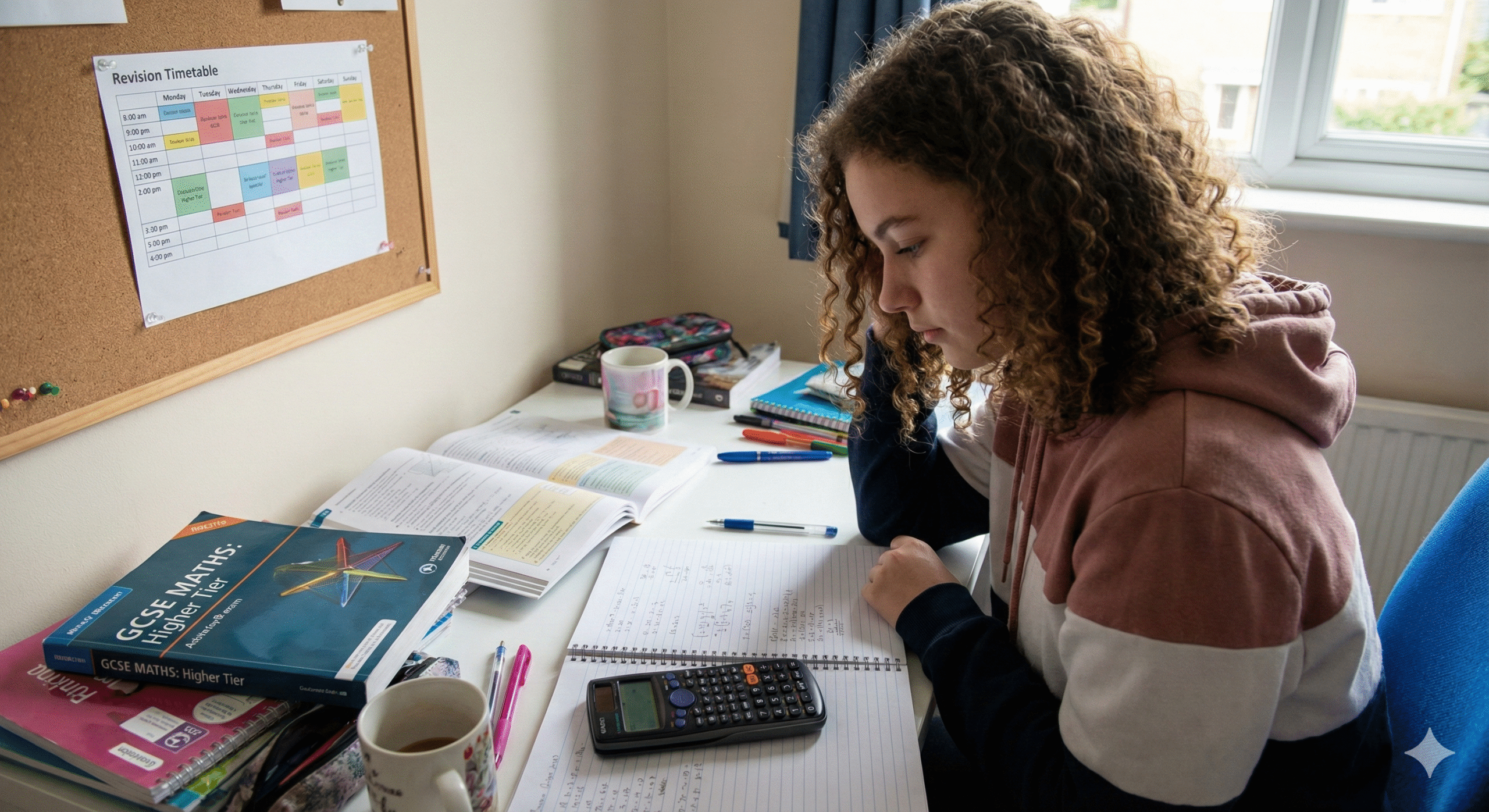
My eldest son has autism and got a Grade 5 in GCSE Maths. I’m genuinely proud of that result, but I’ll be honest – I spent most of his GCSE years not really understanding what he was being taught or how the grading worked. The school assumed we knew, he couldn’t always explain what he was struggling with, and I felt completely locked out of a process that was hugely important for his future.
I spent thirty years as a mental health nurse, so I’m used to breaking down complex information in ways that reduce anxiety rather than increase it. But when it came to GCSE Maths, I was in the same boat as most parents – the curriculum has changed, the grading system is different, and half the terminology sounds like it was invented specifically to make us feel inadequate.
This guide exists because I don’t want other parents – whether their kids have additional needs or not – to feel that same frustration. You don’t need to be a maths expert to support your teenager through their GCSEs. You just need to understand what’s actually happening so you can recognise when they’re struggling and know what help is available.
Why GCSE Maths Feels Like a Different Subject
If you did O-Levels or even early GCSEs yourself, the maths your teenager is doing will look and feel completely different. It’s not just that you’ve forgotten it – the system has genuinely changed.
The 9-1 Grading System
Gone are the old A*-G grades. GCSE Maths now uses numbers from 9 (the highest) down to 1 (the lowest). A Grade 4 is considered a “standard pass” – roughly equivalent to the old Grade C. A Grade 5 is a “strong pass” and is what many colleges and sixth forms look for as a minimum entry requirement.
Here’s what the grades roughly mean:
- Grades 7-9: equivalent to the old A and A* grades
- Grades 5-6: equivalent to the old B and strong C grades
- Grade 4: equivalent to the old C grade (standard pass)
- Grades 1-3: equivalent to the old D-G grades
The jump between grades isn’t equal either. Getting from a Grade 4 to a Grade 5 requires significantly more marks than getting from a Grade 2 to a Grade 3. This is why you’ll hear teachers talking about “grade boundaries” – they’re the minimum marks needed for each grade, and they shift slightly each year depending on how difficult the exam was.
For more detail on how GCSE exams work overall, including grading and exam boards, I’ve written a separate guide that covers all the subjects.
Foundation Tier vs Higher Tier
Around Year 10, schools make a decision about whether your child will sit the Foundation or Higher tier papers. This is a bigger deal than it sounds.
Foundation tier covers Grades 1-5. Higher tier covers Grades 4-9. Notice the overlap at Grade 4 and 5 – that’s deliberate, but it means if your child is sitting Higher tier and has a really bad day, the lowest they can achieve is a Grade 4. If they’re genuinely struggling with the content, that’s a risky position to be in.
There’s no shame in Foundation tier. A solid Grade 5 on Foundation is worth exactly the same as a Grade 5 on Higher – it opens the same doors for college and apprenticeships. What matters is getting the grade they need, not which tier they sat.
Why It Feels Harder
The content itself has expanded. Your teenager is covering more topics than we did, and some of those topics – probability trees, Venn diagrams, algebraic fractions – barely featured in old O-Levels or early GCSEs. The exams also test problem-solving more than they used to. It’s not enough to know how to do long division; they need to recognise when a wordy question is actually asking them to do long division and then apply it correctly.
This is why you’ll see your child staring at a question that looks like it’s written in a foreign language. They might know the maths – they just can’t decode what the question is actually asking for.
The Big Topics Broken Down
GCSE Maths is split into several core areas. You don’t need to teach any of this – that’s the school’s job – but understanding what each area covers helps you recognise what your teenager is grappling with when they come home frustrated.
Number
This is the foundation – working with whole numbers, decimals, fractions, and percentages. It includes things like:
- Calculations without a calculator (yes, really – one of the three exam papers is non-calculator)
- Fractions, decimals and percentages interchangeably
- Standard form (writing very large or very small numbers efficiently)
- Estimating and rounding
This is the stuff that underpins everything else. If they’re shaky on fractions, algebra becomes much harder because algebra is essentially arithmetic with letters instead of numbers.
Algebra
Here’s where it gets abstract, and where many students hit a wall. Algebra is about using letters to represent unknown numbers and then manipulating equations to find what those numbers are.
Key concepts include:
- Solving equations (finding the value of x)
- Expanding and factorising brackets
- Straight-line graphs and their equations
- Quadratic equations (where x is squared)
- Sequences and patterns
If your teenager says they “don’t get algebra,” it’s often because they’re not solid on the basics. Algebra requires you to follow rules precisely, and if they’re skipping steps or guessing, it falls apart quickly.
Ratio and Proportion
This is real-world maths – recipes, map scales, converting currencies, working out best value in shops. It includes:
- Simplifying ratios
- Sharing amounts in given ratios
- Direct and inverse proportion
- Percentages of amounts and percentage change
- Compound interest and depreciation
This is one of the more accessible topics because students can often visualise what’s happening, but the exam questions can be worded in deliberately tricky ways.
Geometry and Measures
Shapes, angles, area, volume, circles, triangles – this section covers:
- Properties of 2D and 3D shapes
- Angles in triangles, quadrilaterals and polygons
- Circle theorems (Higher tier only – and notoriously difficult)
- Pythagoras’ theorem and trigonometry
- Area, perimeter, volume and surface area
- Transformations (reflection, rotation, translation, enlargement)
Geometry tends to suit visual learners, but it requires accurate drawing and measuring. Many marks are lost simply because students don’t use a ruler or don’t measure angles properly with a protractor.
Probability and Statistics
This is about data – collecting it, representing it, and interpreting it. Topics include:
- Mean, median, mode and range
- Drawing and interpreting charts and graphs
- Probability of single and combined events
- Venn diagrams and probability trees
- Sampling methods
The statistics side is usually fine – it’s logical and methodical. Probability is where it gets weird, because our intuition about chance is often wrong, and the notation (writing probabilities as fractions or decimals) can trip students up.
The Language Barrier: Terms Your Teen Will Use
Your teenager will come home talking about maths using words you might not recognise. You don’t need to memorise these, but knowing what they mean helps you understand what they’re stuck on.
Integer: A whole number – can be positive, negative, or zero. So 5 is an integer, but 5.3 isn’t.
Prime number: A number that can only be divided by 1 and itself. Examples: 2, 3, 5, 7, 11. (Note: 1 is not a prime number, which catches a lot of students out.)
Surd: Your teen will come home talking about leaving answers “in surd form” – basically, instead of working out that √3 = 1.732…, they leave it as √3 because it’s more accurate. Teachers are particular about this.
Coefficient: The number in front of a letter in algebra. In 5x², the coefficient is 5.
Factorising: Putting brackets back into an expression. The opposite of expanding.
Hypotenuse: The longest side of a right-angled triangle, opposite the right angle. Comes up constantly in Pythagoras and trigonometry questions.
Congruent: Shapes that are exactly the same size and shape. Identical.
Similar: Shapes that are the same shape but different sizes – all the angles are the same, but the sides are scaled up or down.
Mean, median, mode: Three different types of average. Mean is what most people think of as “average” (add them all up, divide by how many there are). Median is the middle value when you put them in order. Mode is the most common value.
Subject of the formula: The single variable that a formula is equal to. In A = πr², A is the subject. “Making x the subject” means rearranging the formula so x is on its own on one side of the equals sign.
You don’t need to quiz them on these, but if they say “I don’t understand how to factorise,” you’ll at least know they’re talking about algebra and brackets rather than something to do with fractions.
How to Help When They’re Stuck
This is where my nursing background actually comes in useful. I spent three decades watching people struggle with information overload, anxiety, and frustration. The skills for recognising when someone genuinely doesn’t understand versus when they’re just overwhelmed are the same whether you’re in a hospital ward or at the kitchen table.
Recognising Genuine Struggle vs Frustration
There’s a difference between “I don’t get this” because they’re tired and frustrated, and “I don’t get this” because there’s a genuine gap in their understanding.
Frustration looks like: snapping at you, saying they hate maths, claiming they’re “just thick,” refusing to try. Often they can do it, but they’re overwhelmed or anxious about getting it wrong.
Genuine struggle looks like: attempting the same type of question multiple times and getting different wrong answers each time, not knowing where to start, misunderstanding the basics of what the question is asking.
If it’s frustration, sometimes the best help is no help – let them take a break, come back to it later, sleep on it. If it’s genuine struggle, that’s when they need intervention, whether that’s from you, a teacher, or outside support.
Questions to Ask That Don’t Require You to Solve It
You don’t need to know how to do the maths to help. Sometimes the most useful thing is just asking the right questions:
- “What is the question actually asking you to find?”
- “Have you done a question like this before?”
- “What’s the first step you think you need to do?”
- “Can you show me an example from your book where they do something similar?”
Often, talking through it out loud helps them spot where they’ve gone wrong. You’re acting as a sounding board, not a teacher.
When to Suggest Extra Resources
If your teenager is consistently struggling with a particular topic – let’s say they’re fine with everything except algebra – that’s when targeted resources make sense.
A good revision guide can make a real difference. The CGP GCSE Maths revision guides are the ones most schools recommend because they break everything down into manageable chunks with practice questions at the end of each section. They’re colour-coded, clearly laid out, and written in a way that doesn’t assume you already understand everything.
For Higher tier students who need more challenging practice, the Pearson Edexcel practice papers give them exam-style questions that match what they’ll face in the real thing.
Online, BBC Bitesize is still one of the best free resources – it covers every topic with explanations, videos, and quizzes. It’s what schools point students towards, so it matches what they’re learning in class.
When to Step Back
Sometimes the kindest thing you can do is recognise when you’re out of your depth and not make things worse by guessing.
If you’re trying to help with homework and you’re genuinely not sure if what you’re suggesting is right, it’s fine to say: “I don’t know, but let’s look it up together” or “This is beyond me – can you ask your teacher tomorrow?”
Don’t pretend to know if you don’t. Teenagers can tell, and it undermines their confidence in both the help you’re giving and their own ability to work it out.
When to Consider a Tutor
If your child is struggling across multiple topics, if their mock exam results are significantly lower than their target grade, or if they’re showing signs of real anxiety about maths, it might be time to consider paid support.
One-to-one tutoring isn’t cheap – you’re typically looking at £25-40 per hour depending on where you are in the country – but if it’s the difference between a Grade 3 and a Grade 4, or a Grade 4 and a Grade 5, it can be worth it.
I’ve written a full breakdown of typical UK tuition costs and how to decide if it’s worth it. The short version: if you’re considering it, have a conversation with your child’s maths teacher first. They can tell you specifically where the gaps are, which makes finding the right tutor much easier.
Foundation vs Higher: What Parents Need to Know
I mentioned this earlier, but it’s worth expanding on because parents often don’t realise how significant this decision is.
How the Decision Gets Made
Usually around the middle of Year 10, sometimes earlier, the maths department will decide which tier each student will sit. This is based on their performance in class, their mock exam results, and their teacher’s professional judgement about where they’re likely to end up.
Schools want to maximise results, so they’re generally making this call in your child’s best interest. But you should know what tier they’re sitting, and if you disagree with the decision, you can ask for a meeting to discuss it.
What It Means for Later
For most college courses, sixth forms, and apprenticeships, a Grade 4 or 5 is the minimum requirement. It doesn’t matter which tier that grade came from – a Grade 5 is a Grade 5.
For A-Level Maths specifically, most schools want to see at least a Grade 7, ideally an 8 or 9, and that means Higher tier. But if your child isn’t planning to take Maths further, then getting a solid Grade 5 on Foundation is absolutely fine and opens all the standard post-16 routes.
Why a Good Foundation Grade Beats a Terrible Higher Grade
If your child is borderline between Foundation and Higher, there’s a real risk they end up sitting Higher, struggling through it, and scraping a Grade 4 or 5 when they could have comfortably got a Grade 5 on Foundation with far less stress.
The Grade 4 is technically a pass, but many colleges want a Grade 5 for competitive courses. It’s also demoralising to work that hard and still only just pass. Confidence matters, especially if they need to resit later.
If the school suggests Foundation tier and you’re worried it’s “giving up,” it’s not. It’s strategic. Your child can still achieve everything they need to achieve with a strong Foundation grade.
The Exam Itself
Understanding the structure of the actual exam helps reduce anxiety – for both you and your teenager.
Three Papers
GCSE Maths consists of three exam papers, all sat in the summer of Year 11 (usually May/June):
- Paper 1: Non-calculator (1 hour 30 minutes)
- Paper 2: Calculator allowed (1 hour 30 minutes)
- Paper 3: Calculator allowed (1 hour 30 minutes)
Each paper is worth 80 marks, so 240 marks in total. The grade boundaries are set after all the exams are marked, based on overall performance across the country.
Foundation papers: each worth 80 marks, covering Grades 1-5
Higher papers: each worth 80 marks, covering Grades 4-9
That non-calculator paper catches a lot of students out. They’ve become so dependent on calculators that basic arithmetic without one feels impossible. This is why schools drill times tables and mental maths methods – it’s not old-fashioned, it’s essential.
What the Grade Boundaries Look Like
Grade boundaries change every year, but to give you a rough idea:
For Foundation tier, you typically need:
- Around 150-160 marks out of 240 for a Grade 5
- Around 120-130 marks for a Grade 4
For Higher tier, you typically need:
- Around 170-180 marks out of 240 for a Grade 7
- Around 130-140 marks for a Grade 5
- Around 100-110 marks for a Grade 4
These numbers shift depending on how difficult that year’s papers were, which is why you’ll hear about “harsh” or “generous” grade boundaries. The exam boards adjust them so that roughly the same proportion of students get each grade each year.
What this means in practice: your teenager doesn’t need to get everything right. On Foundation, they can drop 80-90 marks and still get a Grade 5. That’s a third of the paper. The pressure isn’t perfection – it’s doing enough, accurately enough, under exam conditions.
How Marks Are Awarded
Maths exams use “method marks” as well as “answer marks.” This means even if your child gets the final answer wrong, they can still pick up marks for showing their working and using the correct method.
This is why maths teachers constantly tell students to “show your working” – it’s not just so the teacher can see where they’ve gone wrong, it’s because in the actual exam, the working is worth marks even if the answer is incorrect.
A student who writes down the right method but makes an arithmetic error might get 4 out of 5 marks. A student who just writes down a wrong answer with no working gets zero. It’s a huge difference.
Why Mock Exams Matter
Most schools run mock exams in the autumn term and sometimes again in the spring term of Year 11. These aren’t just practice – they’re a diagnostic tool.
Mock results tell you:
- Which topics your child is solid on
- Which topics need urgent attention
- Whether they’re managing their time properly in the exam
- Whether they’re reading questions carefully or rushing
If the mock results are significantly lower than expected, that’s your warning signal. You’ve still got several months to address the gaps before the real exams. Use that time wisely – whether that’s focused revision at home, after-school intervention sessions the school might offer, or bringing in outside help.
Don’t panic about mock results, but don’t ignore them either. They’re telling you something.
Resources That Actually Work
You don’t need to spend a fortune on resources, but having the right tools makes revision much more effective than just rereading notes.
Revision Guides
The CGP GCSE Maths revision guides are the gold standard. They cover every topic clearly, include practice questions, and are written in a way that doesn’t assume you already understand everything. Most schools recommend them.
There are separate books for Foundation and Higher tier, so make sure you’re getting the right one for the tier your child is sitting.
Practice Papers
Once your teenager has revised a topic, they need to practice it under exam conditions. The Pearson Edexcel practice papers are proper exam-style questions that match what they’ll face in the real thing.
Practice papers show them what the exams actually feel like – the time pressure, the wording of questions, the mix of easy and difficult questions. Doing these under timed conditions in the weeks before the exam is one of the most effective revision strategies.
Free Online Resources
BBC Bitesize – comprehensive coverage of every topic with videos, explanations, and quizzes. It’s free, it’s reliable, and it matches the curriculum exactly.
Corbettmaths – a website run by a maths teacher with thousands of practice questions, video tutorials, and worksheets. Many teachers use this in class, so your child might already be familiar with it.
MathsGenie – similar to Corbettmaths, with topic-by-topic questions and video explanations. Particularly good for Higher tier students.
All of these are free and all of them are used by schools, which means they’re trustworthy.
When a Tutor Makes Sense
If your child is struggling consistently, if mock results are well below target, or if they’re showing genuine anxiety about maths, one-to-one tutoring might be the answer.
I’ve written a detailed guide about typical UK tuition costs and how to decide if it’s worth the investment. The short version: tutors typically charge £25-40 per hour, and if it’s the difference between passing and failing, or between a Grade 4 and a Grade 5, it can genuinely change post-16 options.
Speak to your child’s maths teacher first – they can pinpoint exactly where the gaps are, which makes finding the right tutor much easier.
Final Thoughts
My son got a Grade 5 in GCSE Maths despite the challenges of navigating the system with autism, and despite me spending most of his GCSE years feeling like I didn’t understand what was happening. That Grade 5 opened the doors he needed it to open.
You don’t need to be a maths expert to support your teenager through their GCSEs. You just need to understand what’s happening, recognise when they’re struggling, and know what help is available.
The system can feel opaque and intimidating, but it’s navigable. Your job isn’t to teach them maths – it’s to make sure they’ve got what they need to learn it themselves, whether that’s the right resources, the right environment to study, or the right intervention when they hit a wall.
And if you’re feeling lost in the terminology and the changes to the curriculum, you’re not alone. Most parents feel exactly the same way. The difference is now you’ve got the context to make sense of it.
If you’re approaching GCSE results day and need to know what happens next, I’ve written a guide to GCSE results day 2026 that covers what to expect, how to appeal if needed, and what your options are depending on the results.